The National
Academy of Sciences (NAS) is considered one of the most (if not the) prestigious groups of scientists in
the US. The National Research Council, their research arm, produces reports
that are ostensibly the pinnacle of objectivity and scientific rigor. But Steve
Hilgartner, in his book Science on Stage,
aims to show that even the pinnacle of scientific objectivity is still
dependent on social processes. While the NAS are considered knowledge experts,
you don’t see behind the curtain. Hilgartner uses the metaphor of stage
management, where the NAS staff, scientists, and report contributors carefully
manage the end products. Deciding something like what nutritional standards to
recommend is obviously not only value-laden, but is also under pressure from
politically motivated food lobby groups, as Marion Nestle shows in her book, Food
Politics.
The NAS doesn’t use overt political rhetoric. Like most
scientists, they strive to be as objective as possible. But Hilgartner shows
that making knowledge claims is political. The NAS uses certain rhetoric to
reify their role as sanctioned experts, and to eliminate sources of
controversy. In an anthropology class I once took, we referred to this as impression management. Like Hilgartner’s
“stage management,” we often consciously and unconsciously say and do things to
create a certain impression of ourselves in different situations. Scientists
engage in the same social process.
So is the NAS’s stage management technique problematic?
Among STS scholars, the answer is “yes.” In fact, James Wilsdon and Rebecca
Willis produced a booklet called “See-Through
Science,” which calls of “upstream engagement” in science policy. As we
discussed in class, this call for more transparent scientific processes and
more space for public deliberation. Two topics we’ve discussed in class:
community-based participatory research and Hispanic girls’ engagement in
science and engineering, both seek to make science more open and transparent to
diverse populations. And already, it’s obvious that the academy is slowly
reacting to pressures to become more open.
In the recent past, most decisions about science policy have
been made by a small group of people: mostly white, mostly male scientists. In
1975 at the recommendation of the NAS, eminent biochemist Paul Berg organized
the well-known Asilomar conference to discuss the ethical implications of
biotechnology. The conference was attended by almost entirely white male
scientists. Wilsdon and Willis quote Sheila Jasanoff, writing, “Thirty years
and several social upheavals later, the Berg committeeʼs composition looks
astonishingly narrow: eleven male scientists of stellar credentials, all
already active in rDNA experimentation” (p. 10). In other words, today we expect decisions about science policy to be made by not only experts, but also issue stakeholders of diverse interests and backgrounds.
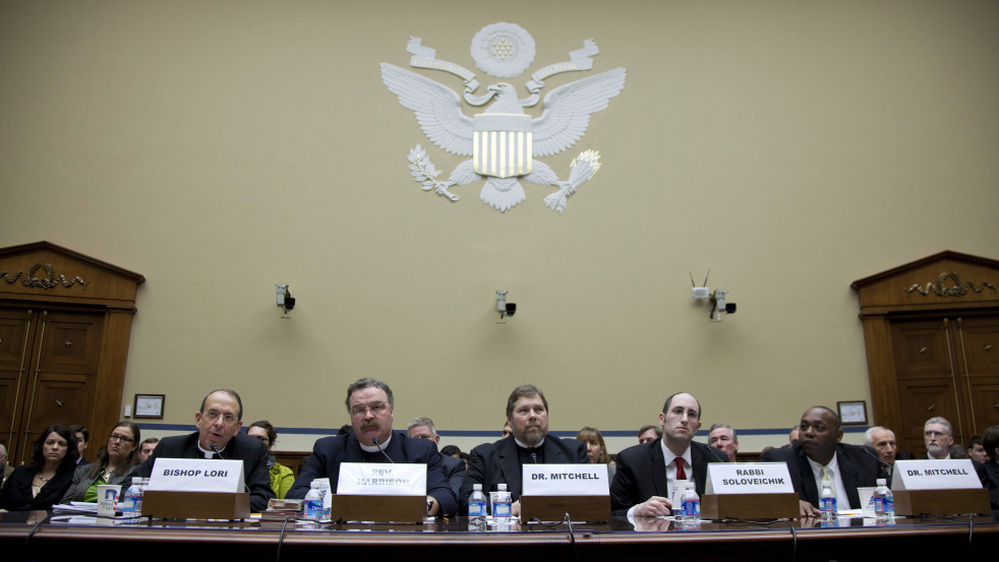
Jasanoff’s words resonate with a current issue: the debate
over insurance coverage of contraceptives. Many of my Facebook friends have
posted responses to this
photo, citing the injustice that not a single woman was able to testify to
Congressional committee on this issue of contraceptive coverage and religion.
The online commentary is very much along the lines of “what is this, 1950?” At
a time where women do have expertise in areas such as law, science, and
religion, they are still not allowed in front of the curtain.
Works referenced:
Stephen Hilgartner, Scienceon Stage: Expert Advice as Public Drama (Stanford, 2000).
Kathy Wilson Peacock, GlobalIssues in Biotechnology and Genetic Engineering. (New York: Infobase
Publishing, 2010).


