
Showing posts with label modernization. Show all posts

February 6, 2012

Science and state power


"Harrowing a field with a diesel tractor, Seabrook Farm, Bridgeton, N.J." c. 1942, Library of Congress.


The connection between science and state power might seem tenuous to those who have not yet drank the Kool Aid. We know that science is used in political debates as the ultimate fact-checker. Is this new drug safe? Let’s do a risk assessment. What’s the trade-off of building this new dam? Let’s have an environmental impact assessment. But to anyone who’s studied the politics of environmental controversies, these scientific measures are hotly contested and imbued with political values.

James C. Scott’s fantastic book, Seeing Like a State, outlines how states have used scientific measurements and standardization to render social life and the environment visible, and thus, controllable. A city map can reflect necessary information like the location of businesses, and the layout of roads.  People are not trackable and taxable unless they have standardized and stable names, land tenure, locations, and ethnicities. But while these simplifications of social life are a necessary abstraction, they miss the nuances of societies, can have systematic flaws, and do not represent local resistance to top-down order (for example. Maps, censuses, and other technologies we use to make complex systems legible also shape how state power interacts with local autonomy. When wheat becomes a commodity to be measured, weighed, shipped, and sold, suddenly “agriculture” is not so much a social process as a means to an end. The mechanization of agriculture seen in the 20th century reflects the expansion of commodity chains due to railroads and steampower in the 19th century. See this post for an example of Scott's "high modernism" theory in China.

In Samer Alatout’s study of water politics in midcentury Israel, he shows how the social construction of water scarcity coincided with expansion of state power and centralization of water technologies. Instead of viewing science and politics as separate spheres, Alatout shows how “water scarcity and the strong centralized state were produced in the same technopolitical process" (p. 962). Focusing on estimates of water supplies in Israel, he writes that for the chief water engineer at the time, Aaron Wiener, “estimate reduction was a step in the right direction, towards a practical, empirical notion of the ‘scientification’ of water policymaking. He commented often on the fact that water policymaking during Blass's reign was anything but scientific” (p. 970).

Water estimates and their role in Israeli foreign policy are a good example of a “boundary object” that is used to negotiate between social and scientific spheres (although as I indicated earlier, the “boundary” itself is not so clear). And interestingly, people who seem the most capable of recognizing these boundary objects are STS scholars and conservatives. Throughout the article, I was thinking about a recent book I read, Merchants of Doubt by Naomi Oreskes and Erik Conway. In this book, the authors show how from the end of WWII and up to today, a group of scientists have used their influence to cast uncertainty on health and environmental reform. These doubt-mongering scientists, some of them hawkish Cold War heroes, believe that liberal environmental politics reek a bit too much of Communism. Smoking bans, acid rain regulations, and climate taxes all represent an expansion of state power over industry, and thus must be attacked in the only legitimate way: through science. They exploit the uncertainty of boundary objects like climate models.

Although Oreskes and Conway’s book is a rich piece of the history of science in politics, there is some unpacking left to do about the role of science and the state. Reading Scott and Alatout, there might be good reason for conservatives to worry about environmental politics being used as a tool to expand state power. Or in the case of climate change, non-state power as well (think “disaster capitalism”).

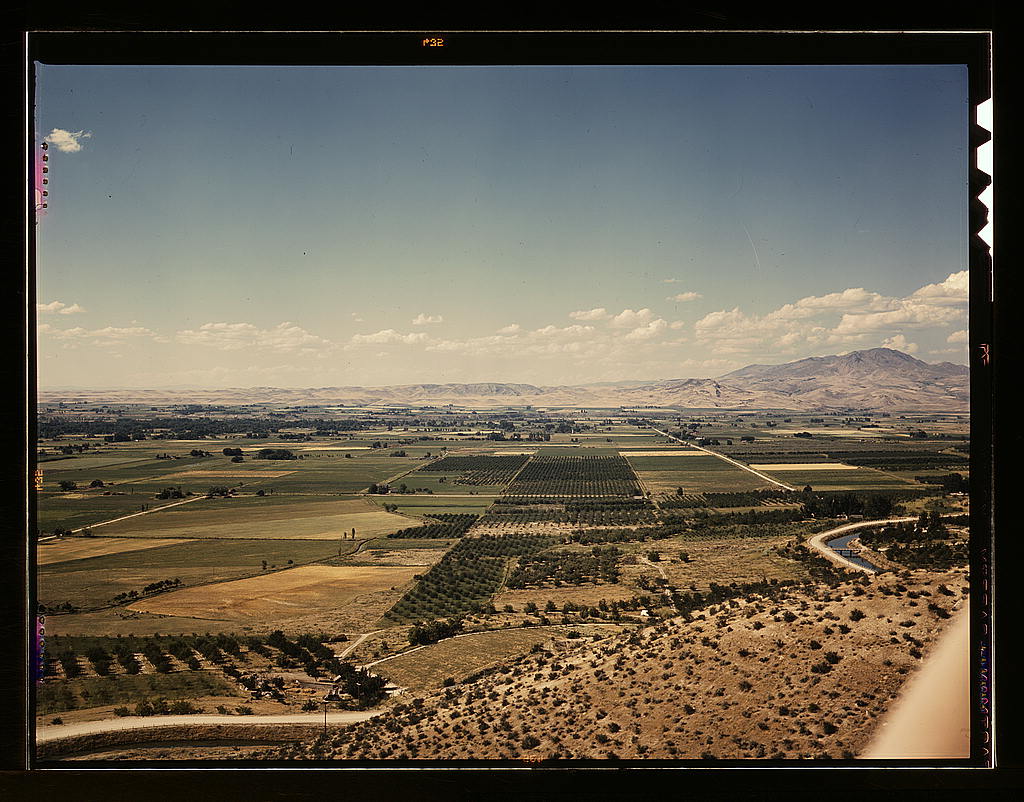
"Cherry orchards, farm lands and irrigation ditch at Emmett, Idaho," 1941, Library of Congress

Guess what, this is my 50th blog post! Many, many thanks to those of you who read, follow, and share my blog. According to Blogger, I've had over 5000 pageviews.

Works cited:

Samer Alatout, “'States of Scarcity': Water, Space, and Identity Politics in Israel, 1948-1959,” Environment and Planning D: Society and Space 26:959-982. 2008.
January 26, 2012

Links I liked, plus some musings on modernization

It's been a busy, stressful week for me. the good news is I've begun contacting potential research hosts in India. The bad news is my last fellowship essay is due on Tuesday. I've applied for three large fellowships this year, and I'm hoping at least one of them will come through. 

But you don't need me to get your fill of science policy news, right? Here's my round-up of links I liked this week.
  • My new (to me) favorite blog: New Security Beat. All about environmental change and national security. Check out some of their latest posts about climate change and security.
  • The New York Times has been running a series of articles on the dark side of Apple's manufacturing plants in China. For more on Apple and global markets, check out these posts by Pielke and Bellemare.
  • XKCD tackles the sustainability of "sustainable."
  • The Biology Files on "The science public information officer: it's complicated."
  • Kate Clancy on "Blogging while female." Online harassment is, fortunately, something I haven't had to deal with on my blog, but Clancy's blogs and others in the female-scientist-blogosphere always keep me on my toes about gender and science issues.
The latest "Food for 9 Billion" radio program by Marketplace features the Philippines, and the transcript is worth a read. There's also a cool interactive graph and timeline to play with. Of course, my favorite part was the interview with Robert Zeigler, director of the International Rice Research Institute (IRRI), who begins by talking about IRRI's role in the Green Revolution.
Robert Zeigler: I think in many ways we're facing challenges that dwarf what we were facing in the 1960s. 
[narrator] That's Robert Zeigler, director of the International Rice Research Institute in the Philippines. This is where those high-yielding rice strains were first developed. Zeigler says with climate change and an increasingly crowded planet, the huge increases of the past may be harder to come by this time around. 
Zeigler: I don't think there's any question that we will want to feed these people and we want them to be well fed and we want them to be well nourished and we want them to be healthy. At the same time, we have to do this in a way that once populations do stabilize that the world we live in is a place we want to live in. 
[narrator] And this is where things get tricky. Zeigler says the demand for rice is expected to grow anywhere from 50-70 percent in the coming years. Meeting that demand without jeopardizing the planet's remaining ecosystems will take a level of coordination and foresight unprecedented in human history. For him, the technological Holy Grail is a bioengineered, photosynthesis-supercharged, rice strain. But such a breakthrough is decades away, if at all. And in the meantime the Philippines, and much of the world, is losing productive farmland, not adding it.
Something I'm really interested in for my own research is how the narrative of the Green Revolution and technological breakthroughs is used to talk about climate change. It is a fairly obvious strategy for agricultural research organizations, despite critiques of the Green Revolution. The sense of urgency due to climate change recapitulates what historian Nick Cullather refers to as IRRI's “Manhattan Project for Food” [source].

Speaking of Nick Cullather, I've become quite interested in modernization theory and Cold War geopolitics lately. So my nerd alert went off when I came across this roundtable discussion of Michael Latham's
The Right Kind of Revolution: Modernization, Development, and U.S. Foreign Policy from the Cold War to the Present. I will definitely have to check the book out.

Here is a particularly interesting excerpt from Corrina Unger's review of the book:
Development often served as an ideology, too, and ideas about development, especially about colonial development were often based on scientific discourses, theories, and concepts.3 There seems to be agreement that modernization was a scientized version of older development ideas, but Latham’s study does not fully explain which difference which kind of science made. Also, it would be worthwhile to inquire into whether we can identify a specifically American type of science behind modernization or if and how transnational and global experiences and encounters transformed its character. [see footnote below
Linked to this problem is the question of definitions, which, for an opaque term like modernization, is of course very difficult. Although Latham does not offer a precise definition, he does identify elements he considers characteristic of modernization: In his view, “the promise of acceleration” and the “perceived potential to link the promotion of development with the achievement of security” were what made American policymakers so enthusiastic about modernization. (3) This is in line with his thesis about the United States’ support of the “right kind of revolution”, a science-based revolution geared toward securing American global interests. Latham excels at contextualizing modernization and its many facets, thereby providing much more than a narrow history of modernization. His engaging account is of interest to anyone concerned with American intellectual, political, and international history.  
[footnote] For recent findings on the scientization of politics after 1945, see the contributions in Archiv für Sozialgeschichte 50 (2010). Also see Sheila Jasanoff, ed., States of Knowledge: The co-production of science and social order (London, New York: Routledge, 2004). On the United States’ transnational ties and its “looping effects”, see Ian Tyrell, Transnational Nation: United States History in Global Perspective since 1789 (Basingstoke: Palgrave Macmillan, 2007).