Showing posts with label communication. Show all posts

March 15, 2012

Are technologies political? Facebook and more


Are technologies political? While baking vegan chocolate chip cookies for a class last week, I wondered if my hand mixer—one of those amazingly durable 1970s machines passed down from my mother—might be imposing some sort of value judgment on me. OK, let’s not anthropomorphize my kitchen gadgets. But Ruth Schwartz Cowan, a feminist historian of technology, would argue that even household technologies have politics behind them, as well as profound social impacts. Consider this recent article in Wired: the design of the keyboard I’m typing on might have a minor impact on the words I unconsciously gravitate towards. Or consider the impact of Facebook on how teenage girls present themselves to the world. Today’s hyper-connected teenagers grow up in a world that is always “on,” and there are social consequences. Maybe I was just a teenage freak, but I when I was in junior high it was cool to wear pajamas to school...

In The Whale and the Reactor, Langdon Winner argues that we should more closely examine the politics behind technologies. He writes, "Over many decades technological optimists have been sustained by the belief that whatever happened to be created in the sphere of material/instrumental culture would certainly be compatible with freedom, democracy, and social justice" (Winner, p. 50). The kicker is, of course, that many of our technologies are not compatible with these ideals. The classic example in agriculture is how the University of California extension system introduced mechanical tomato harvesters. This not only changed the physical properties of tomatoes in the supermarket (bred to be durable, rather than tasty), but created an economic barrier that made smaller farmers go out of business. Other agricultural technologies, such as the fertilizer/seed/pesticide packages of the Green Revolution, and genetically modified foods, also favor larger farmers. This seems to not just be because larger farmers have more capital, stronger networks, and are thus earlier adopters of innovation, but there also something inherently autocratic in the technologies and throughout their development.

These themes are central tenants of Science and Technology Studies’ co-production idiom. Politics shape science and technology, and these in turn shape society. But society pushes back, too. From housewives who started using telephones for social calls rather than ‘business’ to farmers who use cell phones to monitor their crops and commodity prices, we have both formal and informal social means to regulate technologies. These would be considered the “social construction of technology” point of view, as opposed to the co-production or even technological determinism I hinted at earlier.

A really great thought experiment on the social construction of technology is the history of privacy. Despite the ever-shifting impacts of technology on electronic privacy and security, there may be a time in the future where no password is safe and every Cory Doctorow explores this in his short story, “Knights of the Rainbow Table” in the Tomorrow Project. When hackers can crack every password code, perhaps new social norms will catch up with technological advancement, in the same way that we don’t constantly rifle through our roommates, officemates, and neighbors’ belongings (unless you are living with a sociopath, in which case, I recommend you leave now!). 

Back to Facebook, I believe that many of these new norms are starting to form. While it may sound silly, teenagers swap online passwords with each other as a sign of trust and intimacy. Before the days of smartphones, I’ve shared passwords with my roommates in cases when I needed to call to check an email, submit an assignment, or banish myself from Facebook (i.e. letting your roommate change your password). I also trust that my Facebook friends won’t share my embarrassing photos beyond the network, but I’m also coming to terms that nothing I do on the internet will ever be completely private.

Although I have a certain faith in how social norms mediate our interactions with technologies, legal regulation is still important. I might trust my friends with silly photos from last Friday night, but I definitely don’t trust a stranger with my bank account.

June 20, 2011

3) Public participation in science: co-production of knowledge


An important theme of Science & Technology Studies is the "co-production of knowledge." When I first started my graduate studies at ASU, this word threw me for a loop because it packs so much meaning into one phrase, but I guess that's the purpose of academic jargon! The co-production of knowledge means, according to Sheila Jasanoff, "the proposition that the ways in which we know and represent the world (both nature and society) are inseparable from the ways we choose to live in it" (Jasanoff, 2004, p. 2).

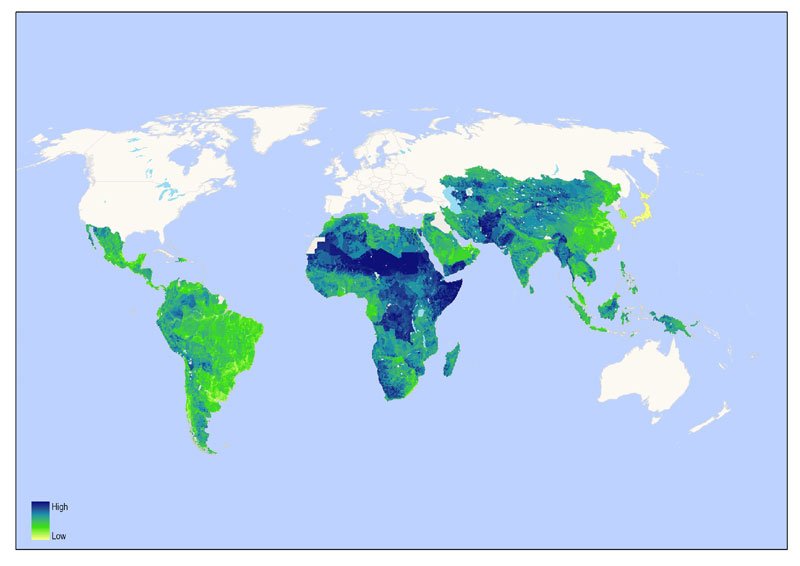
Jasanoff's definition incorporates how knowledge shapes both science and social order (sometimes simply described as the co-production of science and policy or society). How we represent knowledge-- through charts and graphs, DNA samples, lie detector tests, brain scans, environmental impact assessments, maps, etc.-- has implications for not just science, but society. For example, a map of climate change vulnerability can show the scientific results of a study, but it also holds implicit values and political implications.
The creators of this climate change vulnerability map chose not to include most developed countries in their assessment, which certainly has impacts of how we view climate change. For example, climate change is sometimes viewed as a problem mostly facing developing countries, and this map reinforces this. Co-production of knowledge and social order goes beyond just media representations of science; it is deeply important for our political system, and how we make decisions based on science.

We often think of science as a top-down, self-regulating hierarchy of experts. But when science gets used in decision-making, it must conform to the ideals of democracy. Science cannot dictate policy decisions, but can be a useful political tool. Thus, incorporating the "co-production" perspective of science and society can make the role of science more clear in these situations, rather than the muddled role it currently takes. For example, Roger Pielke Jr. shows how the Intergovernmental Panel on Climate Change (IPCC) ignored the "co-production of knowledge" and instead engaged in what he calls "stealth advocacy" of policy. If the IPCC was more upfront about the political implications of their climate change assessments, they would act as more of an "honest broker" of the co-production of science and policy.

Several scholars have examined climate change knowledge from a co-production perspective. Vogel et al. (2007) examine the connections between co-production and science communication. Commenting on many of the topics previously discussed in this blog, they use the case study of food security and climate vulnerability assessments in southern Africa, and how crossing the science-practice boundary through stakeholder engagement resulted in more useful assessments that could be utilized by local organizations and governments. By recognizing the needs of stakeholders, the knowledge gained from these assessments can be used in more democratic ways.

Lemos and Morehouse (2005) look at the case study of NOAA's regional integrated science assessment (RISA) program (coincidentally, the Great Lakes basin now has a GLISA program). The Southwest RISA used a process of stakeholder dialogues to produce a regional assessment of climate change impacts that was relevant and useful to end users. The authors write,

"Co-production of science and policy in the context of integrated assessment activities requires substantial commitment to the three components we have identified: interdisciplinarity, stakeholder participation, and production of knowledge that is demonstrably usable." (Lemos & Morehouse, 2005, p. 66)
In this case, the RISA aimed to produce scientific knowledge about climate change that would be useful for decision-makers like farmers and policy-makers. Without the stakeholder participation, the researchers would not have known how the information would be applied, and how to shape their research based on this. For a more detailed description of other RISA climate change programs, see this report.

For the climate change and agriculture project I'm working on with Michigan State University Extension and Kellogg Biological Station, we are trying to follow the model of stakeholder participation from the start. This is based partly on the work of our colleagues in the Southeast climate RISA and participatory process used to create their AgroClimate website. There are also great examples of using participatory focus groups and community dialogues in forestry and bioethics. Personally, I can tell you that something I've already learned is how important social science research is to this process. The natural sciences can tell us a lot about our world, but social science helps tell us what decision-makers need for knowledge and support. The results are often surprising and definitely eye-opening for those of use entrenched in academia. And this is why co-production of knowledge is important! Recognizing that the process of knowledge production (aka science) is just as important as the end results, and that how the end results are used is often pervasively social and political, STS can lend us some valuable insights for practical results.