In the meantime, I recently had a publication through Michigan State University Extension on local food systems and greenhouse gas emissions. Here's the link to the pdf. What's the connection, you ask? Well, read it to find out! It's aimed at consumers, so it will explain some of the basics behind each concept, and what are some of the main contributions of food and agriculture to greenhouse gas emissions. While some of the specifics are aimed at Michigan consumers, I hope that it applies to a broad audience to help understand the connections between food and the environment.
Perspectives on science and innovation in the face of global environmental change.
Showing posts with label food policy. Show all posts
September 4, 2012
Local food systems and greenhouse gases
I deeply apologize for the lack of updates on this blog, but you will (hopefully!) be pleased to know that I am now a PhD Candidate in Biology and Society and I am soon headed to India for some preliminary research!
April 18, 2012
Food politics: Marion Nestle's "Why Calories Count"
I haven't actually read Marion Nestle's Why Calories Count yet, but I am getting the gist of it through her great blog, Food Politics. Now I'm sure you already know about my fascination with the history of calories and food politics, as I previously wrote about. So I can't wait to get her book!
In a recent post, Nestle writes,
If you want to understand calories, you need to know the difference between calories measured and estimated. Most studies of diet, health, and calorie balance depend on self reports of dietary intake and physical activity or educated guesses about the number of calories involved. Most diet studies rely on estimates. When it comes to anything about calories in food or in the body, you have to get used to working with imprecise numbers. That is why it works better to eat smaller portions than to try to count calories in food. Even small differences in the weight of food will throw calorie estimations off. [emphasis added]This struck a chord with a recent class discussion. We were discussing democratizing science, and our instructor referenced a concept developed by Donald Mackenzie in his book, Inventing Accuracy, which is the "certainty trough." People extremely close to an issue, likely scientists, perceive the exact uncertainties of the issue. A great analog here is climate scientists, who are very careful to not underestimate the uncertainty associated with climate change. But others involved in the climate regime, such as practitioners and activists, perceive a lower uncertainty- they are in the "certainty trough." To outsiders, uncertainty is perceived as even higher- for example, climate might be seen as an "act of God" or a random event like weather. Also, there are actors manufacturing and exploiting uncertainty, as Naomi Oreskes and Erik Conway show in their book, Merchants of Doubt.
So as Nestle says, for food practitioners, i.e. anyone who eats, "you have to get used to working with imprecise numbers." No matter how much nutritional scientists narrow down the science of metabolism, it is still highly dependent on biological factors unique to our own bodies. Food and diet are a series of constant experiments where we must embrace uncertainty.
This concept of embracing uncertainty applies to more than just food consumption, but also to other parts of the food system. I've been working on publishing a factsheet on greenhouse gas emissions from food systems, and the truth is, there is a high degree of uncertainty within the system, making it very difficult to get an exact measurement of the "food miles" or "carbon footprint" of any one food. But this shouldn't paralyze us from making common sense changes, be it in our diet (eat less meat, buy less packaged/processed food, buy only what you will eat) or in our agricultural and commercial processes. As Nestle suggests, "get organized; get motivated... eat less, move more, eat better and get political."
March 7, 2012
Science in Democracy review
Mark Brown’s Science in Democracy: Expertise, Institutions, and Representation is a political
philosopher’s take on science policy. Brown begins with two assertions: 1) that
involving lay people in science
policy debates doesn't make it any less politicized, and 2) when science is
used as a proxy battle for politics, this brings up the question of
representation. Exploring the history of how scientific and political thinkers,
such as Machievelli, Locke, Boyle, Newton, and Latour, Brown draws connections
between the arguments of political philosophers and their applications to
modern science. Mainly, the question of representation in science.
By now a
familiar argument to me, Brown starts off writing about the politicization of
science and the scientization of politics; how science is a proxy battle for
politics, or values. He writes, “Both modern science and modern liberalism
connect elite reason with popular consent, while ensuring that the former
retains power over the latter. The tension between the rationalism and
voluntarism of liberal representative government thus parallels the tension
between the exclusivity and publicity between democracy and political
representation” (Brown, p. 91). Thus, Brown argues that science policy debates
cannot be opened up to the entire population, for the same reasons that we do
not have a direct democracy.
Brown’s
arguments sharply counter Steve Hilgartner’s Science on Stage, which I discussed a few weeks ago. Let’s take two
examples: birth control and food politics. Brown begins and closes his book
with a discussion of the scientization of the debate over Plan B birth control
around 2005-2006, and whether Plan B should be allowed without a prescription.
Again, not a new argument to me, conservatives argued that more evidence was
needed to prove the safety of Plan B. Just recently, the Obama
administration was challenged by feminist groups because they denied
approval to sell Plan B over-the-counter to minors. Obama made a similar
argument, that there is not enough information on Plan B’s effect on minors to
authorize it.
Another example
of Brown’s case against science policy free-for-alls is in setting nutritional
standards. For example, how do children’s cereals get away with advertising
their products as healthy? The answer is a convergence of a scientized
definition of nutrition combined with the strong influence of food lobby
groups. To Brown, this is an example of the failure of representation
(companies are represented, consumers are not), but also a closer examination
of the values that go into science policy processes. He writes, “public
deliberation and representation is required, not only in cases of obvious
technical failure or public controversy, but also at the front end of technical
development… political representation not only requires technical expertise but also occurs within technical expertise” (Brown, p. 89).
An interesting
aspect of Brown’s argument is that “scientific representations that ‘stand for’
nature–especially when institutionalized as expert advice–play a key role in
political representation” (Brown, p. 4). He compares this with Hobbes’s
analysis that “the authority to represent nature’s interests, from this
[Hobbes’s] perspective, does not directly rest on knowledge about nature, but
rather on the formal authorization by those with legal control over it” (Brown,
p. 130). Obviously we might find this problematic when dealing with
environmental issues like climate change and ecosystem services.
February 16, 2012
Corporations and regulatory paradigms: organic foods
Just a few weeks after the chemical company BASF announced that it would move its headquarters from Europe to the US due to continued European public and political resistance against GM crops, it's announced that the US and EU have decided to recognize each others' organic standards, allowing free trade of organic foods between the two regions.
It's important to remember that not all organic food is grown in the US, and that we already recognize the organic standards of some other countries. In fact, many people have been critical that we import organic fruits and vegetables from New Zealand, since it seems to eliminate any environmental benefit intended from organic production.In the NPR article, they write,
Samuel Fromartz, author of the book Organic, Inc. and editor of the Food and Environment Reporting Network, says the different parts of this international movement were talking to each other from the beginning, and they came up with very similar practices.
"You were going to avoid pesticides; you were going to avoid chemical fertilizers; you were going to rely on natural means, enriching the soil through compost," he says.
Eventually, though, groups of farmers realized that they needed rules and a system of certification to make sure that anybody using the label "organic" was actually following those rules.This is certainly true. While "organic" started as a philosophy, it was eventually codified into USDA standards (which, interestingly, conflicted with existing international standards for organics). I've been interested in this issue for a while, since I've always been a bit skeptical about what "organic" really means. In undergrad I wrote my first real research paper on this topic, and I later worked in a lab where we tested organic pesticides.
After a study abroad trip to New Zealand, I researched the comparative evolution of organic standards between the US and New Zealand. In both cases, corporations were highly important in setting the standards, but with very different consequences. In the US, corporate involvement in setting organic standard spurred over half a million responses to proposed federal regulations in 2003, one of the biggest consumer responses ever.
But the main difference between the two countries is that while scholars like Julie Guthman argue that organics in the US have been corporate from the start, organic regulation evolved differently in New Zealand. New Zealand food corporations are very sensitive to their export market, so they implemented regulations that were in line with existing international standards. I explained this in my research paper:
"Prior to standard certification of organic foods and corporate involvement, many consumers and farmers saw organic farming as a fringe movement, characterizing farmers as “sandal-wearing hippies” (Campbell & Fairweather, 1998, p. 35). These hippies, who were indeed radicals in their rejection of conventional agriculture, were inevitably affected by the shift of organic foods from a social movement to simply an alternative method of production. In the early stages of organic certification in New Zealand, these farmers were encouraged to preserve their alternative identity in order to sustain the social aspect of organic farming. The NZBPC [New Zealand NZ Biological Producers Council] held face-to-face interviews and evaluated farmers based on “Product, Place and Person,” but “Person,” or personality, was the most important criteria for early certification (Campbell & Liepins, 2001, p. 30). This ensured a preservation of the organic philosophy, rather than certification of producers just looking for a profit.
The 1990s signaled a shift in New Zealand’s organic agriculture production and serves as a functional model of interdependence between small-scale farmers and corporations. Several corporations became major factors in the growing trend towards organic agriculture in New Zealand... The global demand for frozen organic foods helped Watties to partner with small farmers, whose produce was frozen and shipped internationally. A parallel situation occurred with Zespri International Ltd. because of a global demand for fresh organic kiwifruit (Coombes & Campbell, 1998). These corporations benefited from the knowledge and production of organic farmers, and the farmers benefited by an increased market for their products. The economic incentives of the organic food market produced a unique, mutually beneficial partnership between parties of seemingly fundamentally opposing viewpoints."
In New Zealand, corporations did not attempt to "water down" organic standards like what happened in the US, partly because New Zealand exports are always under the global scrutiny of "green protectionism." Corporations were more willing to act as a catalyst to help smaller farmers become organic, rather than just subsume them into a massive corporate system that we have in the US (see this great infographic by my former professor on the corporate chain of US organics).
Sources:
Campbell, H. & Fairweather, J. R. (1998, September). Development of Organic Horticulture Exports in New Zealand. Agribusiness and Economics Research Unit, Research Report No. 238.
Campbell, H. & Liepins, R. (2001). Naming Organics: Understanding Organic Standards in New Zealand as a Discursive Field. Sociologia Ruralis, 41(1), 21-39.
Coombes, B. & Cambell, H. (1998). Dependent reproduction of alternative modes of agriculture: Organic farming in New Zealand. Sociologia Ruralis, 38(2).
February 1, 2012
Foreign policy, food security, and climate change
President Johnson visiting the International Rice Research Institute in 1966. Related video here.
I recently submitted a fellowship proposal where I framed my research in terms of National Security. This is part of my proposal.
Foreign policy
between the U.S. and India has evolved around Indian food security since 1946, beginning
with an era of grain exports from the fertile U.S. Midwest to famine-stricken
India [1]. The twin problems of overpopulation and Communism in India provoked U.S.
responses, foremost President Johnson’s Food for Peace program in 1959. From
1965-1966, President Johnson and his national security advisers used the Food
for Peace program as a bargaining tool with India to promote a transition from
food aid to self-sufficient Indian grain production [2]. This coincided with
efforts by the United States Agency for International Development (USAID) and
private foundations to overhaul India’s agricultural research infrastructure
and the transfer of new agricultural technologies [1].
The confluence of
foreign policy and scientific advances led to the highly productive agricultural
system of northwestern India from the 1970s to present; this is known as the
Green Revolution. Today, the yield gains of last century’s Green Revolution
have now stagnated. A convergence of demographic, ecological, and climate
factors threaten India’s agricultural yields and food security. By 2030, northwest
India may once again become food insecure, threatening the political stability
of this region [3]. My research will focus on how climate change is impacting
food security in northwest India, and the capacity of agricultural research to
address climate change adaptation.
Northwest India
is historically important for international agricultural science, and today
faces the new threat of climate change. My research will examine both the
institutional and technological dimensions of climate adaptation in
agriculture. Technologies such as climate-tolerant crop varieties are invoked
as future solutions to counter new climate constraints on crop yields [4]. Yet
in an agricultural research system that is diverse and has inevitable time lags
for crop variety development, it is uncertain
whether the existing research system has the capacity to address new, highly
uncertain global challenges like climate change. My research will
critically assess the capacity of agricultural research to address climate
change adaptation in northwest India, particularly in the state of Haryana.
Regardless
of current climate change mitigation efforts, agriculture must adapt to an
uncertain climate future. India’s
ability to adapt to climate change is crucial to U.S. national security. The
U.S. military calls climate change a “threat multiplier” to existing foreign
policy tensions: exacerbating food insecurity and political instability
especially when food prices rise sharply [5,6]. India itself faces
several national security threats due to climate change and food insecurity, from
Bangladeshi climate refugees to water resource-based conflict along the
Pakistan border [7]. Indian agriculture is especially vulnerable to climate
change,
and scholars warn that the Green Revolution style of agriculture lacks
resilience to climate pressures and shocks [3,4].
My research is
particularly focused on sustainable development, and how agricultural
innovation can support resilient local economies, gender equity, and local
democracy. Sustainable development is increasingly intertwined with “climate smart”
development: development that is sensitive to both climate mitigation and
adaptation goals. Indian agriculture is tied to rural livelihoods, and climate
change can compound existing gender and income disparities [8]. Leichenko and
O’Brien call this the “double exposure” model [9]. I experienced these
overlapping factors during a three-month internship in Bangladesh in 2008. While
working for a non-governmental organization, I studied farmers’ adoption
of a new hybrid rice variety. I interviewed male and female farmers and found that
many scientists and policy-makers (wrongly) assumed that women did not farm
rice; thus excluding women from education about hybrid rice and access to
agricultural inputs. My research will examine the how agricultural research
systems address sustainable development goals through climate change
adaptation.
[1]
J.H. Perkins, Geopolitics and the Green
Revolution (Oxford University Press, Oxford, 1997).
[2] K.
Ahlberg, Diplomatic History 31, 4 (2007).
[3]
N. Chhetri, P. Chaudhary, Journal of Disaster Research 6, 5 (2011).
[4]
S.J. Vermeulen et al., Environmental
Science & Policy 15, 1
(2012).
[5] F.
Morring, Aviation Week & Space
Technology 166, 16 (2007).
[6] R.
Naylor, W. Falcon, Population and
Development Review 36, 4 (2010).
[7] N.
Pai, The Indian National Interest Policy
Brief no. 1 (2008).
[8] K.L.
O’Brien, et al. Global Environmental Change 14,
4 (2004).
[9] R.M. Leichenko, K.L. O’Brien, Environmental
Change and Globalization: Double Exposures. (Oxford University Press, Oxford,
2008).
November 28, 2011
Foodsheds and resilience
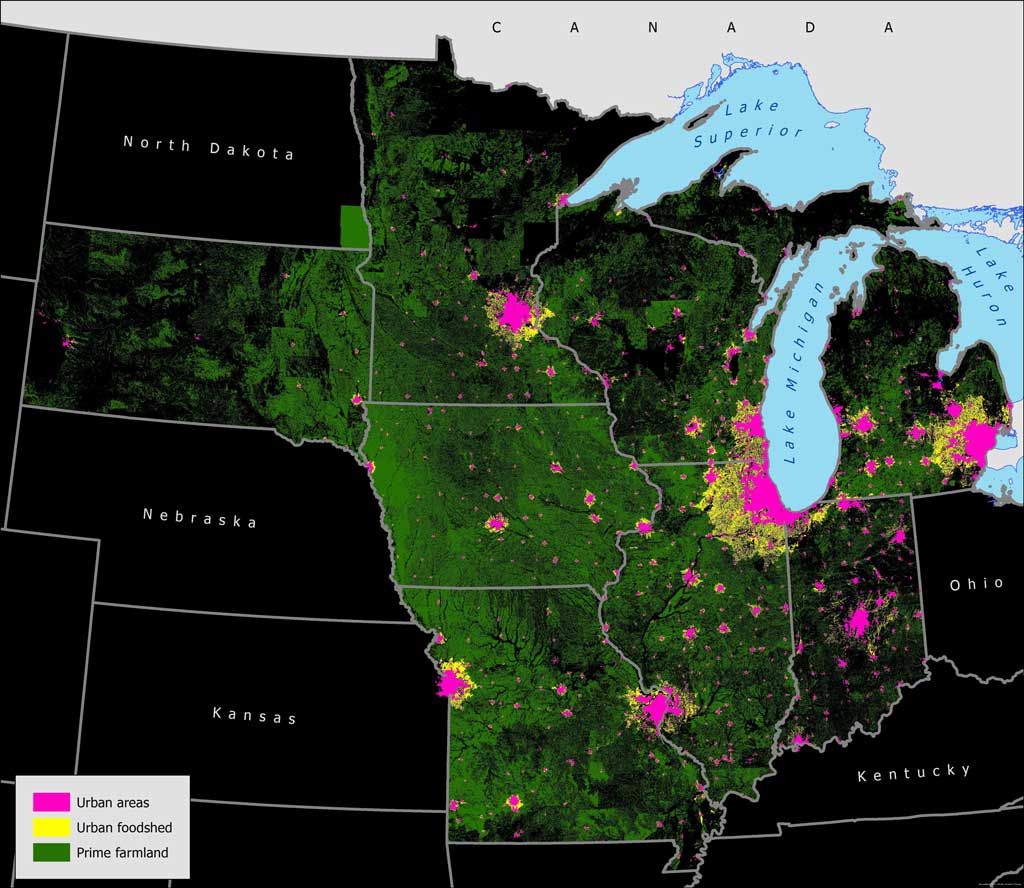
Two quick updates: one is that I totally love these pictures of upper Mississippi "foodsheds." This is related to a project I'm working on with some MSU colleagues, and these images are great. They also relate to a recent book I read, William Cronon's Nature's Metropolis. It is about the history of commodities and land use change in Chicago. It's long, but really interesting to think about the geographical flow of nature and capital throughout the Great West.
Also, tomorrow I'm giving my first real lecture to a large class! It's going to be on climate change vulnerability, adaptation, and resilience. I asked my students to read this article. The process of writing and putting together this lecture has actually helped me solidify some of my own thoughts on these subjects. The problem is I have to keep them fairly simple for my audience. Email me if you'd like to see my slides!
Subscribe to:
Posts (Atom)